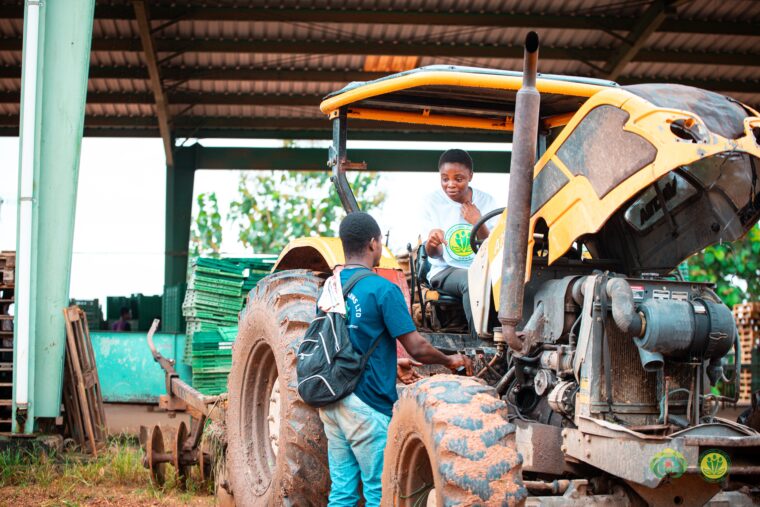
Women are central to Ghana’s agricultural production, processing and marketing, yet may have fewer opportunities to learn to operate farm machinery. Equal access to technical training and modern mechanisation can help them realise their potential, improve their employment prospects and participate in higher-value activities across the agricultural value chain. Promoting women’s participation in mechanisation also supports the broader international development agenda, whereby gender barriers are broken down in farm automation.
The Agribusiness, Entrepreneurship and Skills Training initiative with Tropigha Farms and the Nkabom Collaborative at UHAS directly supports Sustainable Development Goals 5 (Gender Equality) and 8 (Decent Work and Economic Growth) by promoting equal access to technical skills. Machinery training equips young women to work on farms, manage their agricultural businesses and expand their own production.
Two female students from the Fred N. Binka School of Public Health have piloted this initiative through a two-week immersive training at Tropigha Farms Ltd. The experience offered an additional lesson on how commercial food production supports food availability and livelihoods.
The students, Doreen Mensah and Paulina Mwinwelle, learned to start and operate a tractor, use its accelerator and gears, steer, identify its components and follow safety precautions. They put these skills into practice by transporting workers and supplies, moving fertilisers between farm locations, supporting spraying, preparing ridges for pineapple cultivation and collecting harvested produce. The programme introduced them to commercial farming and built practical mechanisation skills in a field where women have traditionally had limited access to technical training. This reflects the Nkabom Collaborative’s commitment to combining academic education with practical skills for employment, entrepreneurship and self-employment.
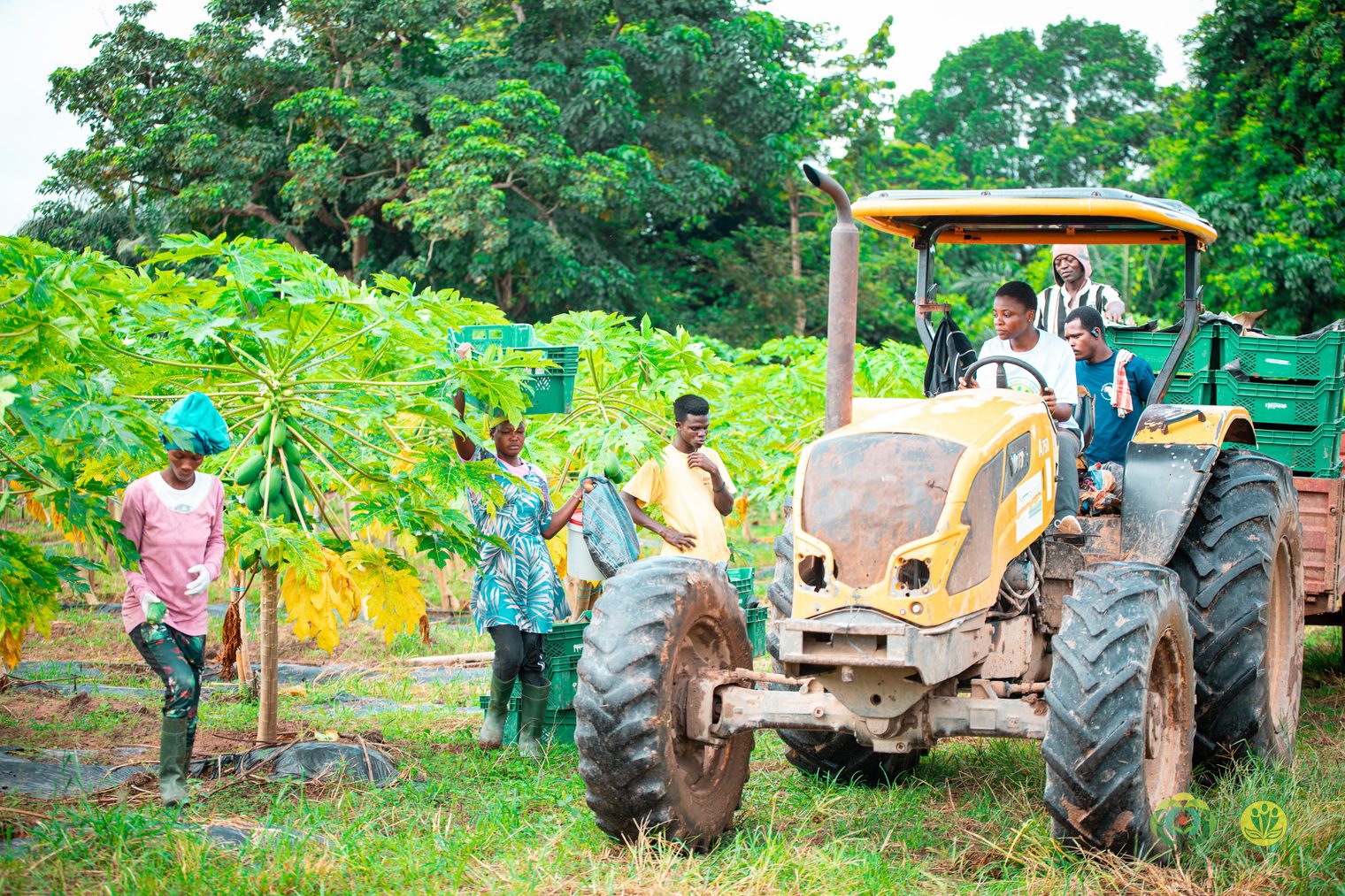
Reversing was Doreen’s greatest challenge when learning to drive a tractor. With patience and repeated practice, she became confident behind the wheel after two weeks of hands-on training. The experience also changed her view of farm work. Growing up, she had watched workers harvest produce by hand and carry it to storage in pans balanced on their heads. She had accepted this as routine, despite the physical strain. “I find that very challenging,” she said.
Another challenge that concerns me most is transporting farm produce to storage facilities after harvesting. This is an issue I can relate to personally because my father is also a farmer. After harvesting, the labourers often must transport the produce manually in pans, carrying small quantities at a time until everything has been moved to the storage facility. This process is labour-intensive, time-consuming, and physically demanding. My experience at Tropigha Limited has given me a better understanding of how mechanisation, particularly the use of tractors and trailers, can help address this challenge by making the transportation of farm produce easier, faster, and more efficient.
For Doreen, learning how tractors support harvesting was especially valuable. A tractor could collect produce and transport it from the field to the storage yard, reducing the need for workers to carry it by hand. At TropiGha, she saw how machinery could ease this burden and improve farm efficiency.
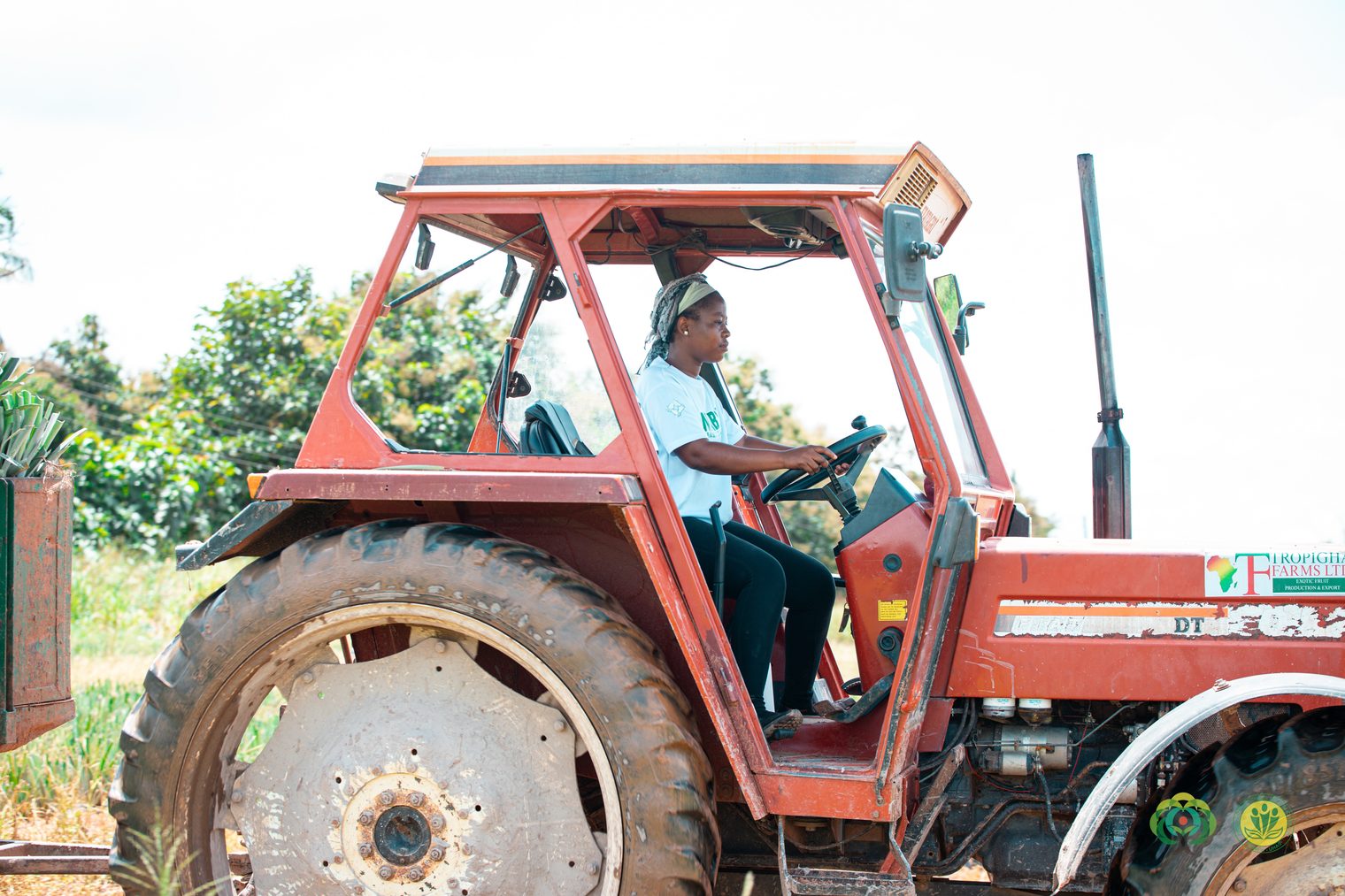
Paulina, who has a maize farm, also gained a new perspective. Before the programme, she had viewed tractors mainly as tools for preparing land. At TropiGha, Paulina has discovered the use of the tractor throughout the production cycle: harrowing land, forming planting ridges, transporting inputs and fertilisers, supporting crop spraying and moving harvested produce to storage. “I only knew that tractors are used for ploughing the land before I start my production,” she explained. ‘The training has strengthened my commitment to farming and encouraged me to think more seriously about mechanisation as part of my farm’s future development. As I work towards expanding my maize production and diversifying into other crops, I recognise the importance of improving my technical skills and adopting more efficient farming practices. The experience has motivated me to continue learning and explore opportunities to make my farm more productive, sustainable, and commercially viable’’.
For Paulina, these insights were directly relevant to her maize farm. She saw how machinery could reduce manual work and improve efficiency, and plans to use it in her next farming cycle
The practical lessons showed the students how mechanisation affects labour needs and agricultural productivity. Both students returned with new technical skills and a deeper understanding of agricultural mechanisation. Paulina gained knowledge she can apply to her maize farm, while learning to drive a tractor expanded Doreen’s sense of what she could do in agriculture.
UHAS-FNBSPH aims to extend this training to more female students through the Nkabom Collaborative’s partnership with TropiGha Farm Ltd., preparing them with practical skills for employment, agribusiness and self-employment after graduation.
University of Health and Allied Sciences
The University of Health and Allied Sciences (UHAS), located in Ho in Ghana’s Volta Region, is a public university dedicated exclusively to training health professionals. Established in 2011 by an Act of Parliament (Act 828), UHAS welcomed its first cohort of students in 2012 and has since grown into a national center of excellence in […]